Experience Task Statements
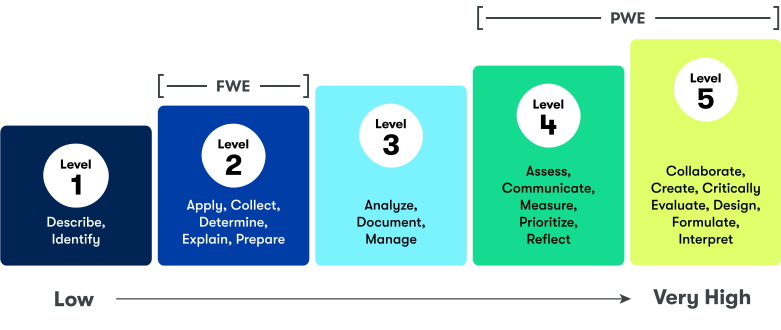
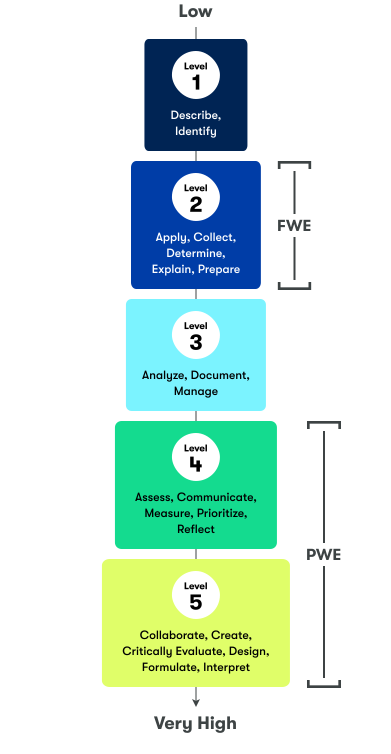
Task Statements are aligned with the Competency Map and define the specific activities and skills you must demonstrate using action-based verbs at proficiency levels 1-5, during your minimum 24 months of experience (net of absences).
Under the Experience Requirements model, CPAs guide and assess you in demonstrating proficiency levels you have achieved against two types of Task Statements: Foundational Task Statements and Professional Task Statements.
For Foundational Work Experience, you must achieve all three Task Statements at a level 2 proficiency.
For Professional Work Experience, the Professional Task Statements that you must achieve are grouped into four experience learning outcome categories and you must achieve the highest proficiency level available in each area (level 4 or 5 depending on the learning outcome).
For the licensure pathway, you must complete the required Professional Task Statements in Financial Reporting and a fifth learning outcome category in Assurance & Trust. All 24 months of experience (net of absences) and the required chargeable hours must be obtained within a firm approved to train students in External Audit.
Successfully achieving these Task Statements at the required proficiency level confirms that you have developed the competencies necessary to become a CPA.
For Foundational Work Experience, a Signatory, who is a CPA and works at the same organization, is required to review and validate your experience. For Professional Work Experience, a CPA Mentor supports and assesses your progress against the approved work plan.
Foundational Work Experience (FWE)
Prepare or explain information for input into internal or external reporting (e.g. financial statements, financial forecasts, financial budgets, management reports).
Identify the users’ needs and prepare practical alternatives or variance analysis which consider the impact on users’ needs.
Explain their analysis, findings in a transparent, understandable and professional manner.
Professional Work Experience (PWE)
Assess decision makers’ needs and actively design the development/modification of reporting requirements or financial-reporting systems required to meet external user needs, such as an MD&A or financing needs (a large, complex example, or several smaller ones).
Critically evaluate and come to a preliminary conclusion on three distinct GAAP (or equivalent) transactions based on requests by management and using the CPA Canada Handbook (or equivalent) as guidance.
Prepare and critically evaluate financial statements and notes in accordance with GAAP or equivalent over two business periods (at least one of which needs to be year end).
Assess the variance analyses on historical, year-over-year financial statements. Interpret the root causes, including insights into interconnectivity of multiple line items (over two business periods, at least one of which needs to be year end).
Assess decision makers’ needs and critically evaluate the development/modification of information data systems required to meet management-reporting needs (a large, complex project, or several smaller ones).
Create a forecast or budget for an entity with multiple and changing input variables across more than two business cycles.
Critically evaluate cost management, revenue management or profitability management for a minimum of two business quarters.
Interpret variance analyses, either with key performance indicators or budgets/forecasts with explanations and/or recommendations (over two business periods, at least one of which needs to be year end).
Through multiple external assurance engagements including high risk or complex sections of the file, you must:
-
Formulate the planning and risk assessment of the assurance engagement (including calculating materiality and assessing the control environment)
-
Design appropriate planned procedures that meet the objective of the engagement
-
Critically evaluate supporting information and results of analysis to draw conclusions and communicate results.
Will have critically evaluated actions and decisions by consistently demonstrating:
-
A questioning mindset
-
Awareness of new information and changes in facts and circumstances which could indicate possible misstatement due to error or fraud (spotting trends and irregularities)
-
Critical thinking skills applied to the evidence (how you interpret the story)
-
Awareness of how conscious and unconscious bias might impact how the data or information is used, analyzed or reported on.
Will have critically evaluated a decision by consistently demonstrating:
-
An understanding of the higher level of accountability and responsibility afforded by being part of the CPA profession
-
Adherence to CPA Ontario’s Student Code including:
-
maintaining the good reputation of the profession, protecting the public and acting in the public interest
-
performing with integrity and due care
-
not allowing professional judgement to be compromised by bias, conflict of interest, or undue influence of others
-
exhibiting behaviours to comply with laws, regulations, organizational policies, societal norms and personal ideals
-
identifying and raising unethical behaviours (if applicable).
-
Will have demonstrated ability to consistently:
-
Communicate analyses, findings, decisions and next steps in a transparent, understandable, and professional manner, with due consideration of audience and appropriate communication channels/tools
-
Assess that all communications fairly reflect underlying substance without bias.